library(tidyverse) # general use
library(janitor) # cleaning data frames
library(here) # file/folder organization
library(ggeffects) # generating model predictions
library(gtsummary) # generating summary tables for models

# temperature data from Ramirez 2024
sonadora <- read_csv(here("data", "Temp_SonadoraGradient_Daily.csv"))Linear regression: Sonadora temperature and elevation example
Set up
Sonadora temperature example
Data from Ramirez, A. 2024. Sonadora elevational plots: long-term monitoring of air temperature ver 877108. Environmental Data Initiative. https://doi.org/10.6073/pasta/6b66eecae3092d8f2340b5132dec38ab (Accessed 2025-05-14).
a. Questions and hypotheses
Question: Does elevation (in meters) predict temperature (in °C)?
H0: Elevation (m) does not predict temperature (°C).
HA: Elevation (m) predicts temperature (°C).
b. Cleaning and summarizing
# creating new clean data frame
sonadora_clean <- sonadora |>
  # clean column names
  clean_names() |>
  # make the data frame longer
  pivot_longer(cols = plot_250:plot_1000,
               names_to = "plot_name",
               values_to = "temp_c") |>
  # separate plot name from elevation
  separate_wider_delim(cols = plot_name,
                       delim = "_",
                       names = c("plot", "elevation_m"),
                       cols_remove = FALSE) |>
  # remove plot column
  select(-plot) |>
  # make sure elevation is read as a number
  mutate(elevation_m = as.numeric(elevation_m))

# summarizing
sonadora_sum <- sonadora_clean |>
  # group by plot and elevation
  group_by(plot_name, elevation_m) |>
  # calculate mean temperature at each elevation
  summarize(mean_temp_c = mean(temp_c, na.rm = TRUE)) |>
  # undo the group_by function
  ungroup() |>
  # arrange in order of elevation
  arrange(elevation_m)
c. Exploratory data visualization
# base layer: ggplot
ggplot(data = sonadora_sum,
       aes(x = elevation_m,
           y = mean_temp_c)) +
  # first layer: points representing temperature at each elevation
  geom_point()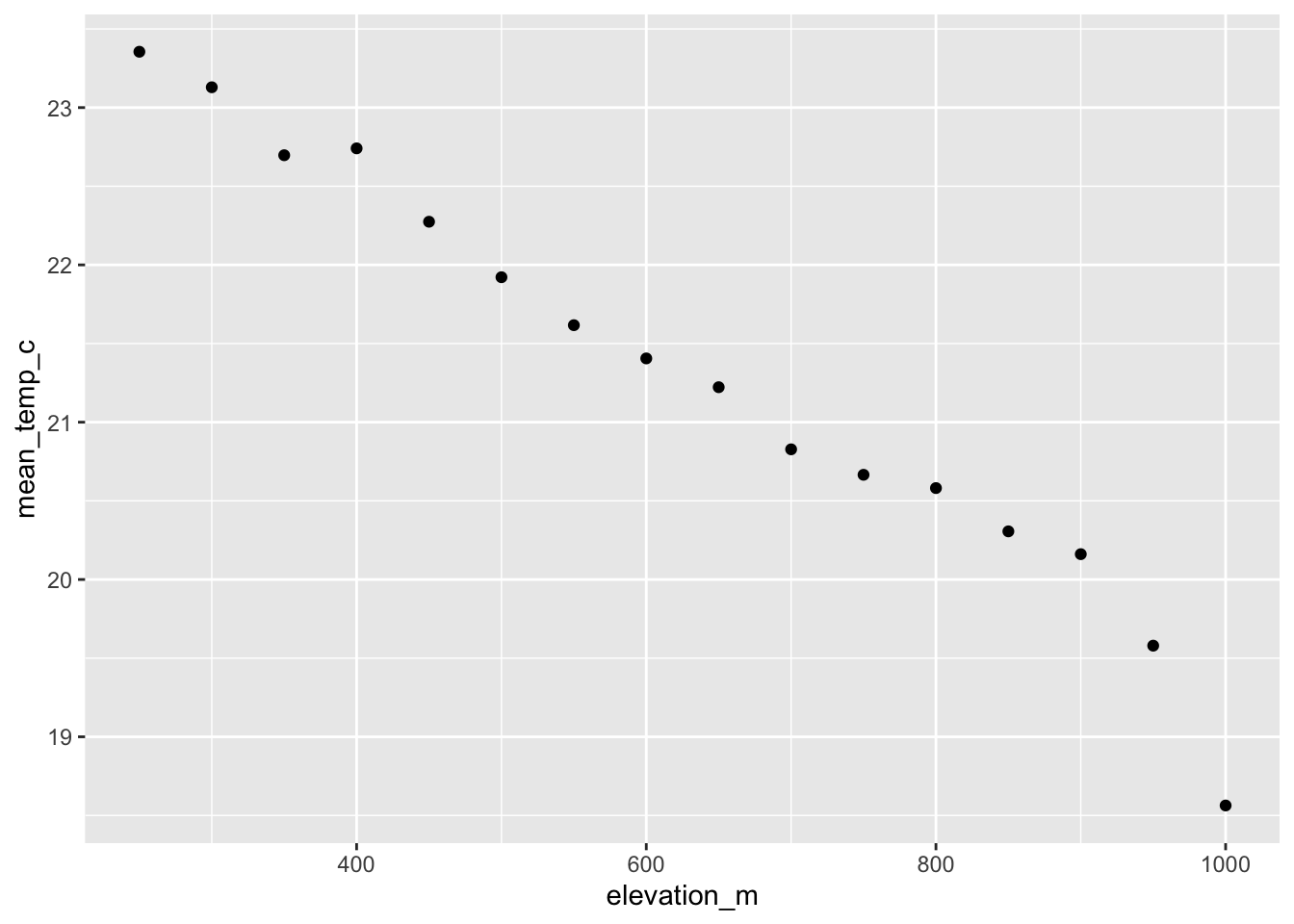
d. Temperature model
# model
temperature_model <- lm(
  mean_temp_c ~ elevation_m, # formula: response ~ predictor
  data = sonadora_sum # data frame
  )
Diagnostics
# diagnostics
par(mfrow = c(2, 2))
plot(temperature_model)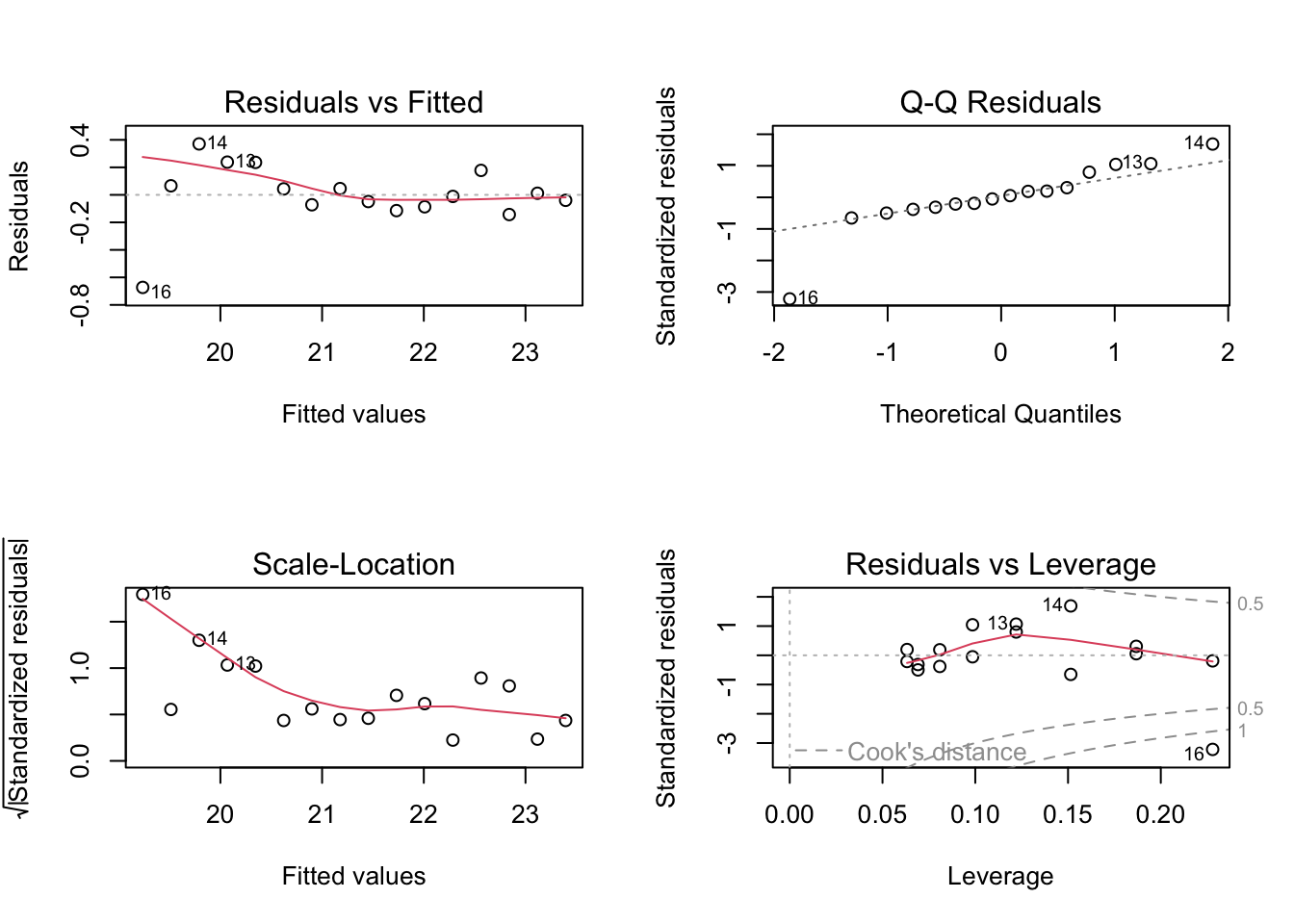
Model summary
summary(temperature_model)
Call:
lm(formula = mean_temp_c ~ elevation_m, data = sonadora_sum)

Residuals:
     Min       1Q   Median       3Q      Max
-0.67288 -0.07577  0.00022  0.09393  0.37042

Coefficients:
              Estimate Std. Error t value Pr(>|t|)
(Intercept) 24.7807991  0.1719438  144.12  < 2e-16 ***
elevation_m -0.0055446  0.0002581  -21.48 4.08e-12 ***
---
Signif. codes:  0 '***' 0.001 '**' 0.01 '*' 0.05 '.' 0.1 ' ' 1

Residual standard error: 0.238 on 14 degrees of freedom
Multiple R-squared:  0.9706,    Adjusted R-squared:  0.9684
F-statistic: 461.4 on 1 and 14 DF,  p-value: 4.075e-12
For each meter of elevation gain, you would expect a decrease in temperature equivalent to 0.01 ± 0.0003 (SE) °C.
Generating predictions
# model predictions
temperature_preds <- ggpredict(
  temperature_model,      # model object
  terms = "elevation_m"   # predictor (in quotation marks)
)

# calculate the temperature prediction at elevation = 900
ggpredict(
  temperature_model,           # model object
  terms = "elevation_m[900]"   # predictor (in quotation marks) and predictor value in brackets
)
# Predicted values of mean_temp_c
elevation_m | Predicted | 95% CI
--------------------------------------
900 | 19.79 | 19.59, 19.99At 900 m, the predicted temperature is 19.8 °C (95% CI: [19.6, 20.0]).
Visualizing model predictions
# base layer
ggplot(data = sonadora_sum,
       aes(x = elevation_m,
           y = mean_temp_c)) +
  # first layer: temperature at each elevation
  geom_point() +
  # 95% CI ribbon
  # uses model prediction data frame
  geom_ribbon(data = temperature_preds,
              aes(x = x,
                  y = predicted,
                  ymin = conf.low,
                  ymax = conf.high),
              alpha = 0.2) +
  # model prediction line
  # uses model prediction data frame
  geom_line(data = temperature_preds,
              aes(x = x,
                  y = predicted)) +
  # axis labels
  labs(x = "Elevation (m)",
       y = "Mean temperature (\U00B0 C)") +
  theme_bw()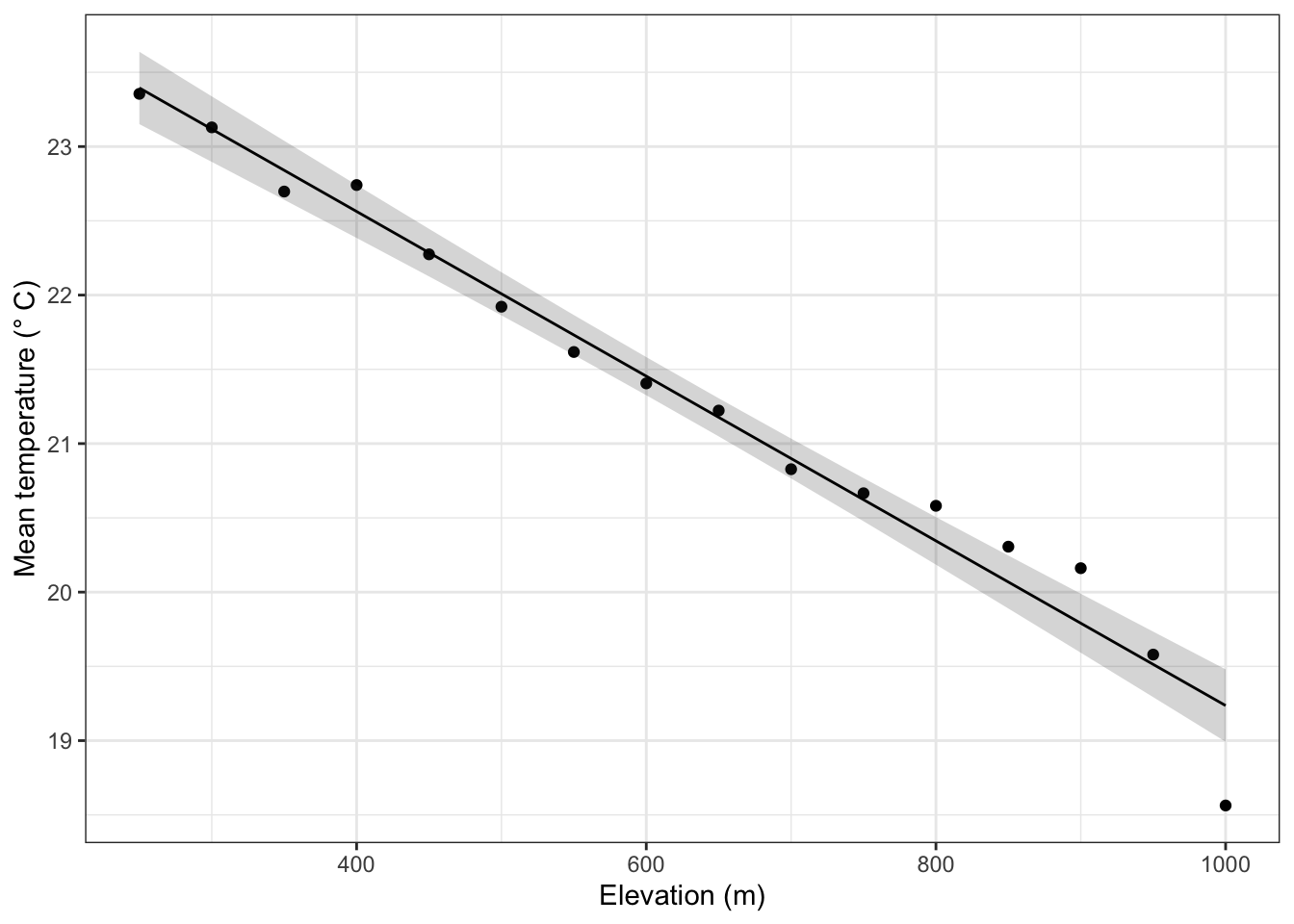
Creating a table with model coefficients, 95% confidence intervals, and more
tbl_regression(temperature_model,
               # make sure the y-intercept estimate is shown
               intercept = TRUE,
               # changing labels in "Characteristic" column
               label = list(`(Intercept)` = "Intercept",
                            elevation_m = "Elevation (m)")) |>
  # changing header text
  modify_header(label = "**Variable**",
                estimate = "**Estimate**") |>
  # turning table into a flextable (makes things easier to render to word or PDF)
  as_flex_table()
Variable | Estimate | 95% CI | p-value |
|---|---|---|---|
Intercept | 25 | 24, 25 | <0.001 |
Elevation (m) | -0.01 | -0.01, 0.00 | <0.001 |
Abbreviation: CI = Confidence Interval | |||
END OF SONADORA EXAMPLE